This major tourism development proposal includes significant active travel infrastructure including cycle routes, parking, and bridleway diversions. However, the cycle parking provision of 440 spaces appears substantially below LTN 1/20 standards for a development of this scale, with no evidence-based justification provided for the shortfall. Crossing types and detailed junction designs for cyclists are not adequately described in the Transport Assessment. While internal permeability and active travel prioritization are positive features, critical details on cycle priority at internal junctions, external route connectivity, and delivery mechanisms remain unclear.

25/02232/OUT
cherwell
25/02232/OUT
Closing date:
AI-generated report — not independently verified. For information only. The reader must verify all content independently before use. Unauthorised redistribution is prohibited.
Key Documents
Transport & Access
- ES Vii Appendix 6.1 Transport Assessment
Primary Transport Assessment containing cycle parking proposals and route assessment methodology
- Transport Assessment
Transport Assessment with cycle parking and external connectivity details
- Transport Assessment Addendum
Transport Assessment Addendum covering updated access design and cycle crossing provision
- ES Vii Appendix 6.2 Travel Plan
Travel Plan including cycle hire scheme and sustainable transport strategy
- ES Vii Figure 3.4 Parameter Plan 03 Access and Movement Footpaths, Footways and Cycle Routes
Parameter Plan 03 showing footpaths, footways and cycle routes layout
- Es Vol Ii Addendum Figure 3.4 Parameter Plan 03 Access And Movement Footpaths, Footways And Cycle Routes Rev B
Updated Parameter Plan 03 (Rev B) for cycle routes and movement
- Parameter Plan 03 - Access and Movement - Footpaths, Footways and Cycle Routes
Parameter Plan 03 proposed plans showing cycle route alignment
- ES Vi C6 Transport and Travel
Environmental Statement Chapter 6 covering transport and travel impacts including cycling
- ES Vii Figure 3.3 Parameter Plan 02 Access and Movement Vehicles and Services
Parameter Plan 02 showing vehicle and service access interaction with cycle routes
Design & Layout
- Design and Access Statement
Design and Access Statement describing active travel hierarchy and movement principles
- Design Codes (rev B)
Design Codes Rev B potentially containing cycle route cross-sections and standards
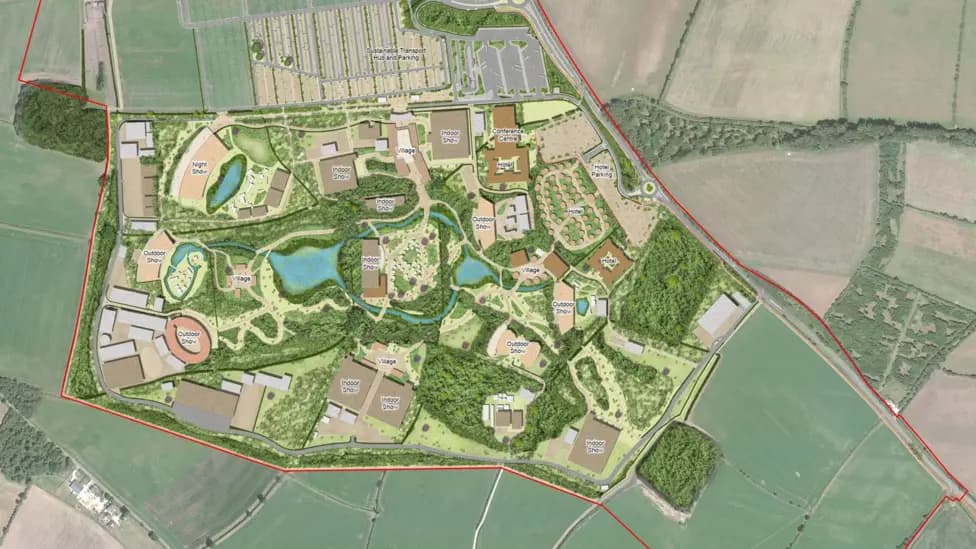
- ES Vii Figure 3.1 Illustrative Masterplan
Illustrative Masterplan showing overall layout and cycle route integration
Assessment Aspects
Cycle ParkingAmber
440 cycle parking spaces proposed but no evidence demonstrates this meets demand for a development including theatres, hotels, restaurants, conference facilities, offices, and warehousing.
Crossing DesignAmber
Transport Assessment does not describe specific crossing types (parallel, toucan, uncontrolled, signal-controlled) at internal or external locations where cycle routes intersect vehicular routes.
Cycle Routes and ConnectivityAmber
Internal active travel routes prioritised and bridleways upgraded to modern standards, but external connectivity to Bicester urban area and rail stations relies on aspirational off-site infrastructure not secured.
Junctions and Internal LayoutAmber
Circular internal road layout and three B4100 accesses mentioned but junction designs for cycle priority, HGV conflict management, and LTN 1/20 compliance not demonstrated.
Permeability and Site IntegrationGreen
Site demonstrates strong permeability with active travel routes on all four boundaries, fine-grain internal network, and prioritisation of walking/cycling over vehicular movements.
Policy Compliance and Strategic AlignmentAmber
Application references LTN 1/20 assessment tools but does not provide results or demonstrate compliance with core design principles for cycle parking quantity and junction safety.
Policy Compliance
Cycle parking must be conveniently located, secure, and provided in sufficient quantity to meet demand
Non-compliant
440 spaces proposed but no evidence provided to justify adequacy for development mix including theatres, hotels, restaurants, conference facilities, offices, and warehousing. No justification provided for departure from LTN 1/20 Table 11-1 standards.
Cycle parking provision for leisure centres at greatest of 1 per 50m² or 1 per 30 seats/capacity for short stay, plus 1 per 5 employees for long stay
Non-compliant
Development includes indoor/outdoor theatres and conference facilities but no capacity/seating data provided to assess compliance. No breakdown of 440 spaces by land use type.
Office/employment cycle parking: 1 per 1000m² short stay, 1 per 200m² long stay
Non-compliant
Development includes offices and warehousing but no floorspace data provided. Staff parking 'in discreet locations' but no quantity specified.
5% of cycle parking to be provided for non-standard cycles (adapted cycles, cargo bikes, tricycles) in most accessible locations
Non-compliant
No mention of provision for adapted cycles, cargo bikes, or accessible cycle parking co-located with accessible car parking.
Walking and cycling routes should be assessed using LTN 1/20 Cycling Level of Service Tool and Junction Assessment Tool
Non-compliant
TA states five external routes assessed using these tools but results not provided in application documents. JAT requires red/amber/green scoring of all cycle movements at junctions - not demonstrated.
Cycle crossings should be selected based on traffic speed and volume using Table 10-2, with priority given to parallel crossings or signal control on busy roads
Non-compliant
Crossing types not specified in TA or Addendum. B4100 likely requires parallel or signal-controlled crossings but type not confirmed. Internal crossing designs not described.
Cycle routes within new developments should form a coherent, direct, safe, comfortable and attractive grid network; protected space for cycling should be provided on major roads
Compliant
Internal site layout prioritises active travel with traffic-free routes. 3m segregated two-way cycle track on B4100 frontage meets protected space requirement. Fine-grain network proposed.
Design codes for new developments should include cycle network plan with typical cross-sections showing quality of provision
Non-compliant
Design Codes Rev B document exists but text-searchable version not available. No evidence cycle network plan with cross-sections included or that LTN 1/20 compliance secured at reserved matters.
Developments should be designed to reduce the need to travel and promote sustainable transport modes including cycling
Compliant
Active travel hierarchy, cycle hire scheme, mobility hub, and traffic-free internal routes align with sustainable transport objectives.
Applications should be supported by a Transport Assessment demonstrating acceptable transport impacts and promoting sustainable transport
Compliant
Comprehensive TA and Travel Plan provided. Stage 1 RSA completed. However, cycle-specific impacts inadequately assessed (parking quantity, junction safety).
Bridleways and Public Rights of Way should be protected and where possible enhanced
Compliant
Three bridleways diverted and upgraded to 5m width with segregation for horses/cyclists/pedestrians to modern standards (Addendum 4.12).
Streets should be designed to accommodate safe and convenient movement by all users including cyclists and pedestrians, with lower vehicle speeds and priority for active travel
Compliant
Internal layout prioritises people over vehicles. Traffic-free routes within park. 30mph speed limit proposed on B4100 near accesses. Movement hierarchy places active travel first.
| Requirement | Status | Notes |
|---|---|---|
| Cycle parking must be conveniently located, secure, and provided in sufficient quantity to meet demand | Non-compliant | 440 spaces proposed but no evidence provided to justify adequacy for development mix including theatres, hotels, restaurants, conference facilities, offices, and warehousing. No justification provided for departure from LTN 1/20 Table 11-1 standards. |
| Cycle parking provision for leisure centres at greatest of 1 per 50m² or 1 per 30 seats/capacity for short stay, plus 1 per 5 employees for long stay | Non-compliant | Development includes indoor/outdoor theatres and conference facilities but no capacity/seating data provided to assess compliance. No breakdown of 440 spaces by land use type. |
| Office/employment cycle parking: 1 per 1000m² short stay, 1 per 200m² long stay | Non-compliant | Development includes offices and warehousing but no floorspace data provided. Staff parking 'in discreet locations' but no quantity specified. |
| 5% of cycle parking to be provided for non-standard cycles (adapted cycles, cargo bikes, tricycles) in most accessible locations | Non-compliant | No mention of provision for adapted cycles, cargo bikes, or accessible cycle parking co-located with accessible car parking. |
| Walking and cycling routes should be assessed using LTN 1/20 Cycling Level of Service Tool and Junction Assessment Tool | Non-compliant | TA states five external routes assessed using these tools but results not provided in application documents. JAT requires red/amber/green scoring of all cycle movements at junctions - not demonstrated. |
| Cycle crossings should be selected based on traffic speed and volume using Table 10-2, with priority given to parallel crossings or signal control on busy roads | Non-compliant | Crossing types not specified in TA or Addendum. B4100 likely requires parallel or signal-controlled crossings but type not confirmed. Internal crossing designs not described. |
| Cycle routes within new developments should form a coherent, direct, safe, comfortable and attractive grid network; protected space for cycling should be provided on major roads | Compliant | Internal site layout prioritises active travel with traffic-free routes. 3m segregated two-way cycle track on B4100 frontage meets protected space requirement. Fine-grain network proposed. |
| Design codes for new developments should include cycle network plan with typical cross-sections showing quality of provision | Non-compliant | Design Codes Rev B document exists but text-searchable version not available. No evidence cycle network plan with cross-sections included or that LTN 1/20 compliance secured at reserved matters. |
| Developments should be designed to reduce the need to travel and promote sustainable transport modes including cycling | Compliant | Active travel hierarchy, cycle hire scheme, mobility hub, and traffic-free internal routes align with sustainable transport objectives. |
| Applications should be supported by a Transport Assessment demonstrating acceptable transport impacts and promoting sustainable transport | Compliant | Comprehensive TA and Travel Plan provided. Stage 1 RSA completed. However, cycle-specific impacts inadequately assessed (parking quantity, junction safety). |
| Bridleways and Public Rights of Way should be protected and where possible enhanced | Compliant | Three bridleways diverted and upgraded to 5m width with segregation for horses/cyclists/pedestrians to modern standards (Addendum 4.12). |
| Streets should be designed to accommodate safe and convenient movement by all users including cyclists and pedestrians, with lower vehicle speeds and priority for active travel | Compliant | Internal layout prioritises people over vehicles. Traffic-free routes within park. 30mph speed limit proposed on B4100 near accesses. Movement hierarchy places active travel first. |
Recommendations
Require a detailed Cycle Parking Strategy prior to commencement that provides: (a) evidence-based justification for cycle parking quantities across all land uses using LTN 1/20 Table 11-1 methodology, including demand calculations for theatres (per seat), hotels (per room), restaurants (per cover), conference facilities (per delegate capacity), offices (per m²), and warehousing (per m² and per employee); (b) phased delivery triggers tied to occupation of each development phase; (c) monitoring regime with provision for additional parking if demand exceeds 85% capacity; and (d) minimum 5% accessible cycle parking provision co-located with accessible car parking, as required by LTN 1/20 para 11.2.6 and 11.3.2.
Require submission of detailed crossing designs for all locations where cycle routes intersect vehicular routes, both internal and at B4100 site accesses, demonstrating compliance with LTN 1/20 Table 10-2 and Chapter 10.4. Crossings on B4100 (40mph+ road) must be parallel crossings or signal-controlled toucan crossings with cycle priority. Internal crossings on vehicle routes must give priority to cyclists via raised tables, continuous footway/cycle track treatment, or signals. Designs must be agreed with Highway Authority prior to any reserved matters approval, as required by LTN 1/20 para 10.4.5-10.4.6.
Require completion and submission of LTN 1/20 Junction Assessment Tool (Appendix B) for all junctions internal to the site and at the three B4100 site accesses, with all cycle movements scored red/amber/green and remedial measures identified to achieve 'green' rating for all movements. JAT outputs must be submitted at reserved matters stage and designs must not be approved unless all movements score 'green' (collision potential removed), in accordance with LTN 1/20 Appendix B methodology.
Require completion and submission of LTN 1/20 Cycling Level of Service Tool assessments for the five identified external routes connecting the site to Bicester urban area and rail stations, with route audits including infrastructure quality, junction safety, and coherence scoring. Identify gaps and secure delivery mechanisms (s106/s278) for off-site improvements required to achieve 'good' or 'very good' ratings throughout, as referenced in TA 11.57 and required by LTN 1/20 Appendix A.
Secure through Design Code or condition that all internal site roads, junctions, and cycle infrastructure at reserved matters stage must comply with LTN 1/20 geometric standards including: 3m desirable width for two-way cycle tracks (2m absolute minimum), 2m width for one-way tracks, 500mm additional clearance to vertical features >600mm, and design speeds of 30kph (20kph absolute minimum) as per LTN 1/20 Tables 5-2, 5-3, and 5-4. Design Code must include typical cross-sections for each route type demonstrating compliance, as required by LTN 1/20 para 14.3.18-14.3.19.
Extend 30mph speed limit on B4100 for minimum 200m either side of each of the three site accesses (not just 'in the vicinity') and provide gateway treatments (visual narrowing, coloured surfacing, signing) to achieve speed reduction in advance of cycle crossings, in accordance with LTN 1/20 para 10.4.5 and Manual for Streets para 7.4.2. Include enforceable speed limit measures in s278 agreement.
Require s106/s278 agreements to deliver continuous cycle route connections from site boundary to: (a) Bicester Village railway station; (b) Bicester North railway station; (c) Bicester town centre; and (d) existing/planned Cherwell LCWIP routes. Contributions must fund design, land acquisition, and construction to LTN 1/20 standards. Trigger: 50% of connection infrastructure completed prior to first occupation of any tourism/visitor uses; 100% completed prior to 50% occupation, in accordance with NPPF para 112(c) requirement to facilitate uptake of sustainable transport.
Require submission of Stage 1 and Stage 2 Road Safety Audits for all internal junctions and site accesses with specific cyclist safety audit terms, including examination of: HGV conflict with cycle movements at servicing access; sightlines for cyclists at all junctions; protection for cyclists from left-turning vehicles; and compliance with LTN 1/20 Junction Assessment Tool. Audit team must include a cycling design specialist as per LTN 1/20 para 10.3.2.
Secure cycle hire scheme delivery and operation through s106, including: minimum 40 docking stations on-site (distributed at mobility hub, conference facilities, hotel entrances, theatre entrances); docking stations at Bicester Village and Bicester North railway stations; maintenance and operating budget for minimum 10 years; and monitoring reports on usage. Trigger: cycle hire operational prior to first occupation of any visitor uses, in accordance with Travel Plan commitments (para 4.14-4.15).
Require Travel Plan to include: annual cycle parking utilisation surveys with trigger for additional provision if >85% capacity reached; cycle mode share targets for staff (minimum 10% target within 2 years) and visitors (minimum 5% within 5 years); and annual reporting to LPA with remedial measures if targets not met, as required by NPPF para 113 and LTN 1/20 para 11.3.5 monitoring principles.
Suggested Conditions
Prior to commencement of development, a detailed Cycle Parking Strategy shall be submitted to and approved in writing by the local planning authority. The Strategy shall include: (a) cycle parking quantities for each land use calculated using LTN 1/20 Table 11-1 methodology with supporting evidence; (b) location plans showing all cycle parking areas including mobility hub, conference/hotel buildings, and staff back-of-house areas; (c) specifications demonstrating covered, secure, and overlooked provision with minimum 5% accessible cycle parking; (d) phased delivery triggers; and (e) monitoring and expansion mechanisms. Development shall be carried out in accordance with the approved Strategy. Reason: To ensure adequate cycle parking provision in accordance with LTN 1/20 Chapter 11, NPPF para 112(c), and to promote sustainable transport.
Prior to submission of any reserved matters application, detailed designs for all pedestrian and cycle crossings of vehicular routes (internal and at site accesses) shall be submitted to and approved in writing by the local planning authority. Designs shall demonstrate compliance with LTN 1/20 Table 10-2 and Chapter 10.4, including crossing type selection based on traffic speed and volume, and shall prioritise cyclists and pedestrians. Crossings on the B4100 shall be parallel crossings or signal-controlled toucan crossings. Internal crossings shall incorporate continuous footway/cycle track treatment or raised tables. Reserved matters applications shall accord with the approved crossing designs. Reason: To ensure safe and convenient cycle crossings in accordance with LTN 1/20 para 10.4.1-10.4.6 and NPPF para 112(a).
Prior to submission of any reserved matters application, LTN 1/20 Junction Assessment Tool evaluations for all site junctions and B4100 accesses shall be submitted to and approved in writing by the local planning authority. Evaluations shall score all cycle movements red/amber/green and identify remedial measures to achieve 'green' rating. Reserved matters junction designs shall achieve 'green' (suitable for all cyclists with collision potential removed) for all movements. Reason: To ensure junction safety for cyclists in accordance with LTN 1/20 Appendix B and NPPF para 112(b) safe and suitable access requirements.
Prior to first occupation of any part of the development, the cycle parking and cycle routes shown on approved Parameter Plan 03 (or reserved matters equivalent) serving that phase shall be laid out, constructed, and made available for use, and shall thereafter be retained for those purposes. Reason: To ensure cycle parking and routes are available from first occupation to promote cycling in accordance with LTN 1/20 and NPPF para 112(c).
Prior to commencement of development, a s278 agreement shall be completed to deliver: (a) 3m segregated two-way cycle track and 2m footway along entire B4100 site frontage; (b) parallel or toucan crossings at each of the three site accesses; (c) 30mph speed limit extension 200m either side of each access with gateway features; and (d) improved cycle crossing facilities at Braeburn Avenue/B4100 junction. Works shall be completed prior to first occupation of any part of the development. Reason: To provide safe access for cyclists in accordance with LTN 1/20 Chapter 6 and 10, and NPPF para 112(a).
The development shall be carried out in accordance with the approved Travel Plan. Within 6 months of first occupation of each phase, and annually thereafter, a Travel Plan monitoring report shall be submitted to the local planning authority including cycle parking utilisation surveys and cycle mode share data. If cycle parking utilisation exceeds 85%, a scheme for additional cycle parking shall be submitted and implemented within 3 months. If mode share targets are not met, remedial measures shall be submitted and implemented within 6 months. Reason: To promote sustainable transport and monitor cycle parking adequacy in accordance with LTN 1/20 para 11.3.5 and NPPF para 113.